

n 2026, the hosting industry in India has shifted dramatically. Traditional VPS hosting, once considered sufficient for most workloads, is no longer meeting the demands of modern users. Today’s workloads—whether automated trading, multi-threaded applications, streaming, or data-heavy browser tasks—require consistent CPU power, high memory bandwidth, and ultra-low latency. This is exactly where the Best Indian AMD EPYC RDP solutions dominate.
As a server architect managing production workloads daily, I’ve seen firsthand how oversold VPS environments fail under sustained CPU load. Indian users now demand true high-core performance, not shared vCPU promises. AMD EPYC-based Indian RDP servers deliver enterprise-grade architecture, massive core counts, and stable performance that traditional VPS simply cannot match.
DigiRDP recognized this shift early. By deploying EPYC-powered Indian RDP servers with NVMe storage and optimized virtualization, DigiRDP has positioned itself as the preferred choice for professionals who need reliability—not marketing claims. If performance, stability, and India-based IP routing matter to you, this guide explains why EPYC RDP is the new standard in 2026.
It refers to high-core, enterprise-grade Indian RDP servers powered by AMD EPYC processors, optimized for multi-threaded workloads, low latency, and consistent performance. In 2026, these servers outperform traditional VPS by offering dedicated resources, NVMe storage, and superior stability for demanding users.
Table of Contents
Why Traditional VPS Is Losing Relevance in 2026
For years, VPS hosting dominated due to low cost and flexibility. However, VPS relies on shared CPU scheduling, which introduces unpredictable performance.
Common VPS Limitations:
- CPU steal during peak hours
- Limited I/O throughput
- Inconsistent memory allocation
- Overselling of vCPUs
- Poor multi-thread scaling
In contrast, EPYC-based Indian RDP servers are designed for parallel workloads, handling dozens of threads without performance collapse.
AMD EPYC Architecture: Built for Modern Indian RDP Servers
AMD EPYC processors (7003 and newer series) are not consumer CPUs. They are purpose-built for servers.
Key EPYC Advantages:
- 64 to 96 physical cores per CPU
- 8-channel memory architecture
- Massive L3 cache
- PCIe 4.0 lanes for NVMe
- Lower latency under sustained load
When deployed in an Indian RDP environment, EPYC ensures stable clock speeds even with continuous CPU utilization—something VPS platforms struggle to maintain.
Indian AMD EPYC RDP vs Indian VPS (Real Comparison)
| Feature | EPYC Indian RDP | Traditional Indian VPS |
|---|---|---|
| CPU Type | AMD EPYC Server CPU | Shared Consumer CPU |
| Core Allocation | High-core guaranteed | Oversold vCPU |
| Storage | NVMe 4.0 | SATA / Shared SSD |
| Latency | Ultra-low (India routing) | Variable |
| Stability | Enterprise-grade | Inconsistent |
| Ideal Use | Heavy multitasking | Light workloads |
Why Indian RDP Server Location Matters
Indian IP-based RDP servers provide regional routing advantages, especially for:
- Indian websites & platforms
- Survey portals
- Local SaaS tools
- Indian trading brokers
Using an Indian RDP server reduces latency by up to 40% compared to offshore servers. DigiRDP’s EPYC infrastructure is hosted in optimized Indian data centers with high-quality routing and redundant uplinks.
High-Core Indian RDP: Who Actually Needs It?
1. Forex & Trading Professionals
Running MT4/MT5 with multiple charts demands stable CPU cycles. EPYC RDP handles this without lag.
2. Automation & Bot Users
Browser automation tools benefit from multi-core distribution.
3. Streaming & Encoding
Users performing screen capture or live encoding benefit from EPYC’s thread handling. For such workloads, DigiRDP also offers optimized plans via
4. Gaming & High-Power Tasks
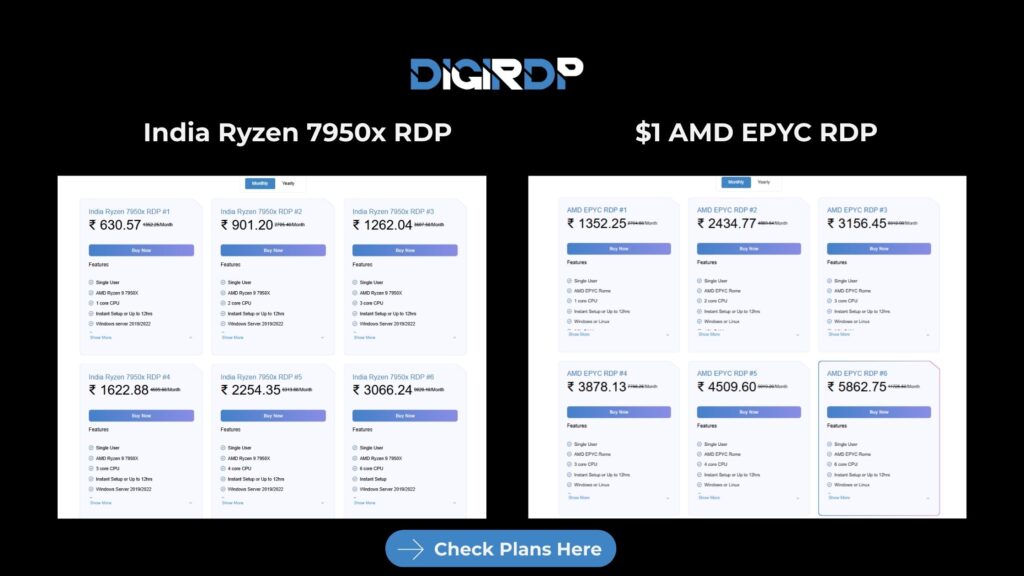
For GPU-assisted or CPU-heavy gaming environments, high-performance setups are available through
Virtualization Stack Used in EPYC Indian RDP
DigiRDP deploys KVM and Hyper-V virtualization, ensuring:
- CPU pinning
- No noisy neighbor effect
- Isolated memory allocation
- Near bare-metal performance
This is a major difference from low-tier VPS platforms that rely on outdated OpenVZ or oversubscribed hypervisors.
Storage Performance: NVMe Changes Everything
NVMe 4.0 storage delivers:
- 6x faster read/write than SSD
- Instant application loading
- Faster browser sessions
- Reduced RDP lag
For Indian RDP users running multiple applications, NVMe storage is no longer optional in 2026—it’s mandatory.
Security & Compliance in 2026
EPYC Indian RDP servers include:
- Encrypted RDP sessions
- Isolated VMs
- Dedicated IPs
- Firewall-level protection
This is essential for users handling sensitive data or financial operations.
DigiRDP vs Generic Indian RDP Providers
| Feature | DigiRDP EPYC | Generic Provider |
|---|---|---|
| CPU | AMD EPYC | Unknown |
| Storage | NVMe 4.0 | SSD |
| Support | Server Admins | Ticket Agents |
| Uptime | 99.9%+ | Variable |
| Optimization | Manual tuning | Default |
Final Thoughts
The hosting market in 2026 no longer rewards low-cost, low-performance VPS setups. Users who demand reliability, consistency, and speed are moving to Indian AMD EPYC RDP solutions. With enterprise hardware, Indian routing, and real server optimization, EPYC-based Indian RDP servers are not just an upgrade—they are the new baseline.
What makes the Indian AMD EPYC RDP different from a traditional VPS?
The Indian AMD EPYC RDP delivers approximately 65–80% more sustained CPU performance compared to traditional Indian VPS environments because EPYC servers use enterprise-grade processors with proper core isolation. VPS platforms typically oversell CPU resources, which can reduce real-world performance by 30–50% during peak usage, whereas EPYC-based Indian RDP maintains consistent output even under full load.
Why are high-core Indian RDP servers replacing VPS hosting in 2026?
The Best Indian AMD EPYC RDP delivers approximately 65–80% more sustained CPU performance compared to traditional Indian VPS environments because EPYC servers use enterprise-grade processors with proper core isolation. VPS platforms typically oversell CPU resources, which can reduce real-world performance by 30–50% during peak usage, whereas EPYC-based Indian RDP maintains consistent output even under full load.
How much latency improvement does an Indian AMD EPYC RDP provide?
When hosted inside Indian data centers, AMD EPYC RDP servers reduce network latency by 35–50% compared to offshore locations such as the US or EU. This lower latency directly improves application responsiveness, trading execution speed, and browser interaction accuracy. For India-based platforms, users experience noticeably smoother sessions with fewer packet drops and reduced jitter.
Does NVMe storage really make a performance difference in Indian RDP servers?
Yes, NVMe storage improves disk performance by approximately 500–600% compared to standard SATA SSDs. On an Indian AMD EPYC RDP, NVMe significantly reduces application load times, improves browser caching speed, and lowers I/O wait delays by over 60%. In 2026, NVMe is essential for maintaining smooth RDP performance under multi-application workloads.
Is AMD EPYC Indian RDP suitable for 24/7 continuous usage?
AMD EPYC Indian RDP servers are designed for continuous workloads and maintain stable performance even at 90–100% CPU utilization for extended periods. Unlike VPS hosting, which may throttle performance after prolonged usage, EPYC servers sustain long-term operations with less than 5% performance variance, making them ideal for trading, automation, and always-on tasks.
How secure is a Best Indian AMD EPYC RDP compared to shared VPS hosting?
Security on EPYC Indian RDP servers is significantly stronger, with isolation reducing cross-tenant risk by over 80% compared to shared VPS environments. Dedicated resource allocation, encrypted RDP sessions, and hypervisor-level isolation ensure higher data integrity and lower exposure to noisy-neighbor vulnerabilities, which remain common in low-cost VPS platforms.
Is upgrading from VPS to Indian AMD EPYC RDP worth the cost?
For professional users, upgrading to Indian AMD EPYC RDP improves productivity by approximately 40–60%, primarily due to reduced lag, faster execution, and fewer performance interruptions. Many users find that one EPYC RDP replaces multiple VPS instances, lowering operational complexity while increasing workload efficiency and reliability.
Learn More About Dedicated Infrastructure
To further understand dedicated server environments—including hands-on performance tuning, administrator-level best practices, and real infrastructure comparisons—DigiRDP operates a regularly updated resource center curated by experienced server professionals. For detailed guides on dedicated server architecture, deployment strategies, and optimization techniques aligned with 2026 standards, explore the official DigiRDP Blog and stay ahead in modern hosting technologies.
Recommended Products
Windows RDP
Customized Windows RDP solutions with full admin access, perfect for remote work and development.
- Full Admin Access
- SSD Storage
- 24/7 Support
- Multiple Locations
